
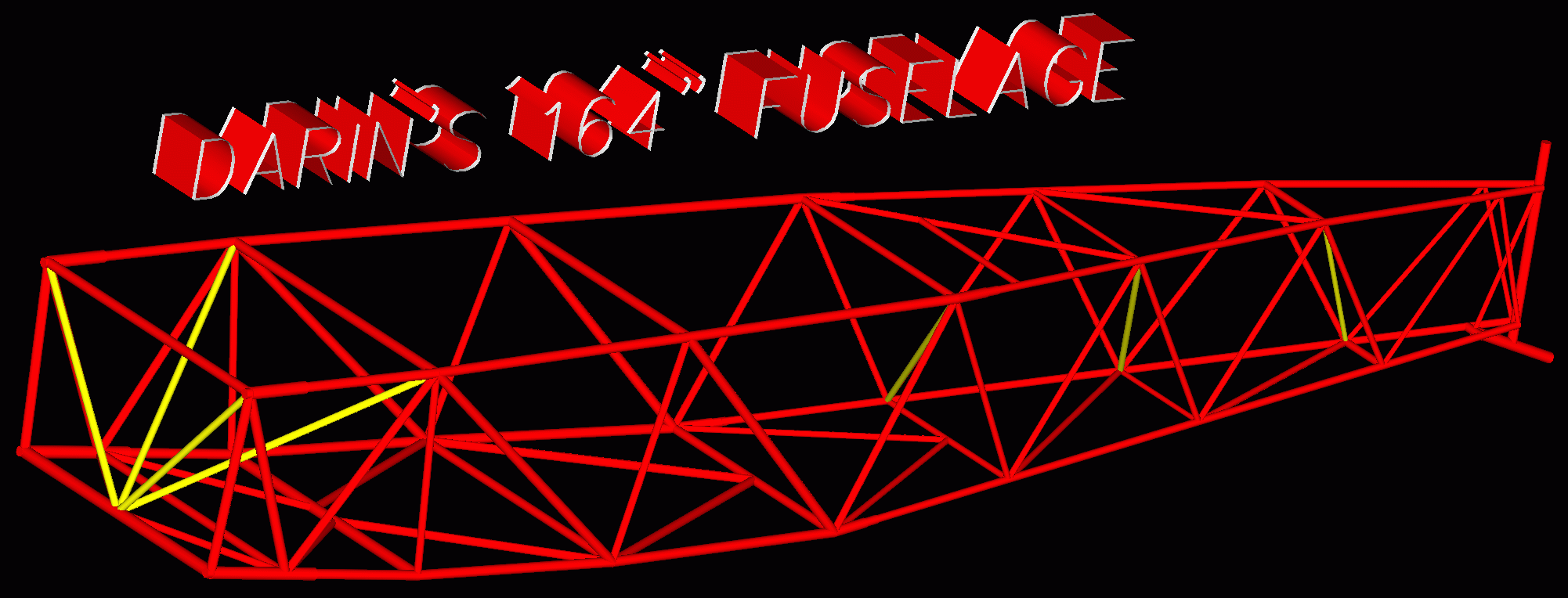
164" Fuselage (5" Shorter Than
Plans)
Click
Below For Basic Dimensions
Design Considerations
INTRODUCTION:
As people look through my website and become more educated about the Pitts
Model 12, some eventually want to know more about the short fuselage I've
built. So, here's the story behind my efforts. First let me state that my
fuselage is not exactly the same as the pre-welded HP fuselages available
from Jim Kimball Enterprises. While my fuselage is very close dimensionally to
Kevin's fuselage, his has been optimized for its new size by Finite
Element Analysis (FEA), and there are little things that he's
done to improve it compared to the plans version. I've tried to
incorporate into my fuselage as many of those improvements as I
could discover, so that I could utilize as many of the Kimball HP
components as possible. Should anyone decide to use the
following information, they do so at their own risk! That being said, I did not
come up with these changes all by myself. Kevin was kind enough to answer
more than a few key questions along the way, and in the beginning it was
done on a collaborative basis, with Tom Weinberger and I sending CAD files
across the planet every few weeks until late August 2000, when I pretty
much settled on the design I have now.
Reasons:
I spent a couple days looking at N360KC during Sun-N-Fun 2000, then when I
saw pictures and drawings of the plans version it seemed too long. I had
been planning to build from scratch all along, but really liked the
shorter fuse, which presented a dilemma. I also planned on building
Kevin's HP wing kit with its shorter span and bigger ailerons. So,
probably like everyone else, I asked Kevin if plans were available for the
short version and when he said no, well the wheels kept spinning. I
liked the short fuse because it looked more in proportion to the short
wings, and probably had slightly better manuverability. I also figured it
must have a weight advantage due to 5 inches less fuselage & 5 inches
less firewall forward. Also I have the added benefit of being able to use Kimball HP parts
like the turtle deck and laser cut fuselage skins for example.
What
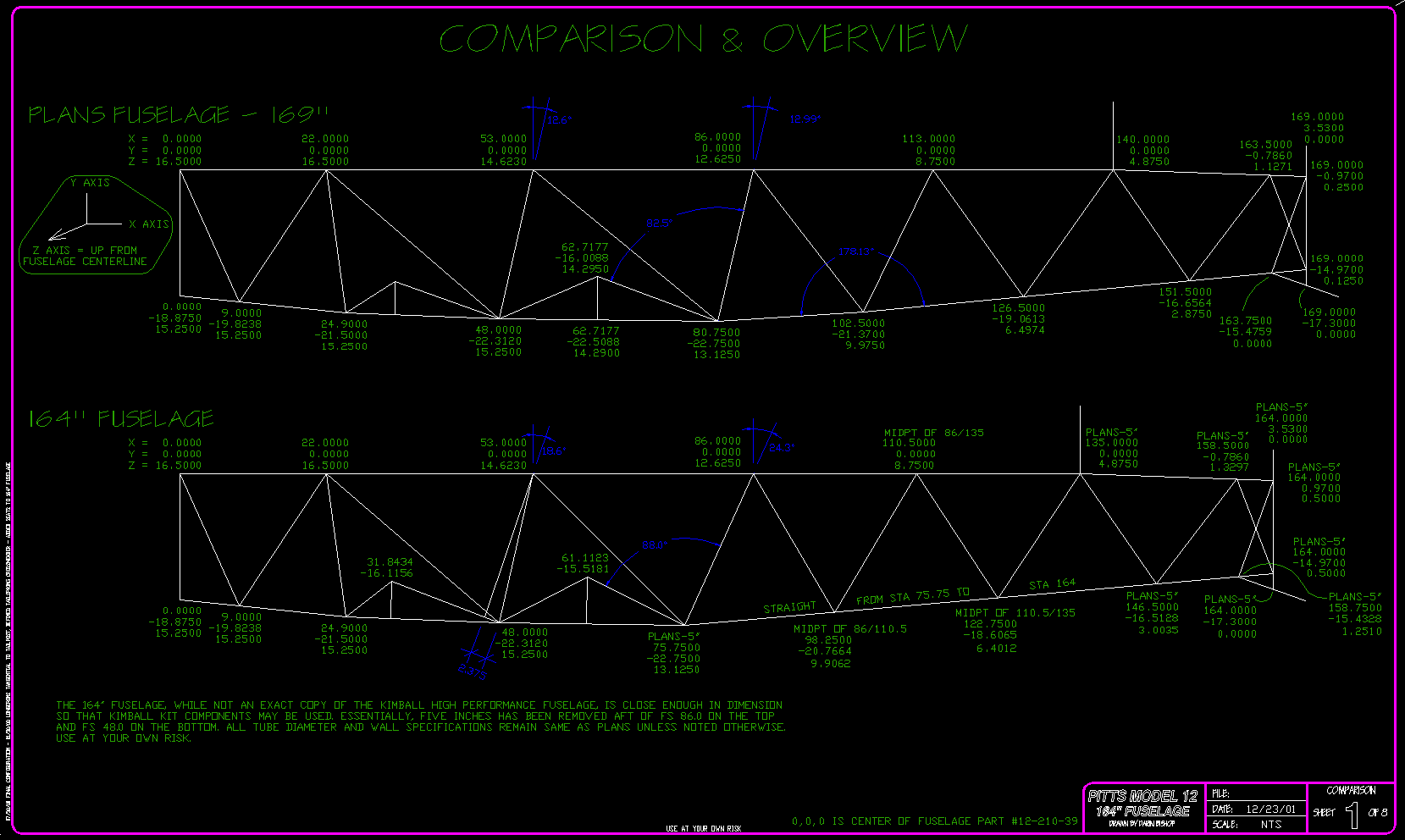
Changed: Looking at the side view, my fuselage is
basically 5 inches shorter than plans, with the 5 inches coming from
between the cockpit and the tail. It's the same as the plans from Fuselage
Station (FS) 0.0 to FS 86.0 on the top longeron and back to FS 48.0
on the bottom. The lower cluster at FS 80.75 got moved forward 5 inches to
FS 75.75. The fuselage at the tail starting at STA 140 on the top and STA
151.5 on the bottom remains the same except all are at plans-5 inches. The
top cluster previously at FS 113 is now at FS 110.5. The two bottom
clusters at FS 102.5 & FS 126.5 are now at 98.25 & 122.75
respectively. I'm not planning on doing a FEA on it since I would assume
it would be stronger as it gets shorter. My fuselage should be slightly
heavier than a Kimball HP fuselage which has been optimized with FEA,
because I'm still using the same tube specifications (tube diameter and
wall thickness) listed in the plans. To quote Kevin, "By doing a
full finite element analysis of the frame, I was able to optimize
the tube sizes while trying to maintain the external appearance of the
plans frame. So, some of my tubes are thinner or smaller or both
than the ones you are planning to use. I changed a few to larger dia
tubes for reasons of convenience of assembly or better fit of a fitting etc
and reduced the wall thickness to make an equivalent strength
member. But, for the most part, our frame will look like yours and
vice versa. I just have ours tweaked a bit more than you will to
save some weight."
Seating
Position: The rear seat bottom slides forward 5 inches
which changes the recline angle from 13 degrees to 24 degrees measured
with the top longeron. Regarding the forward seat, the backrest tubes
at the bottom get welded to the seat bottom tubes 2.5 inches forward of
the FS 48 cluster. This results in a recline of 19 degrees compared
to 13 degrees in the plans.
Building
Considerations: Shortening the fuselage made all the
nice dimensions on the fuselage side flat pattern
layout useless, so I had to figure out another way to do it. The
sides of the Pitts 12 fuselage actually twist from firewall to tail, but
the top and bottom ladders only bend on one axis. In fact the top
ladder is flat except the last crossmember to the tailpost. What I've
done is calc the little extra needed in the bottom and top ladders so
that they can be built flat on the table, but put the clusters at the
proper locations after bending. I just added up the tube intersection to
intersection distances with the help of my CAD program. I built the bottom
ladder first, then the top ladder. Using the engine mount to help up
front, I then jigged the bottom ladder above the top using wood boxes cut
to the proper height at each station, and worked my way back to the tail
post.
Other
Notes: I had to redraw the elevator control system to
adjust the lengths of the pushrods and the rear idler, to keep the
geometry as close as possible. Per Kevin's advice the Torque tube remains
the same, and I used a curved rear stick tube from Kevin to allow more
rear seat clearance. The Kimball HP engine mount, cowl, turtle deck,
canopy and sheetmetal panels are used. My fuselage is about 1/2"
longer than a Kimball HP fuselage and most stations are within 1/4"
so I will use the HP weight and balance data.
CONCLUSION: After spending a LOT (understatement) of time making my fuselage and tail parts from scratch, and the numerous visits to the Kimball's hangar documented on this website, I can honestly say that the fuselage and tail feathers they sell have tremendous value. Sure, you can save some money by building your own and trading time for money, but in the end you will probably have paid yourself less than $20 an hour so be forewarned. I mostly wanted to build my fuselage myself for the education, challenge and pride of building something myself instead of just paying for it. Its been a lot of fun too.